You Won’t Believe What I Found at Siem Reap’s Morning Market
Shopping in Siem Reap isn’t just about souvenirs—it’s a full cultural immersion. I wandered through bustling markets, where the scent of lemongrass and handwoven silk filled the air. Every stall told a story, from ancestral crafts to street food made the same way for generations. This is more than retail therapy; it’s a living connection to Cambodian heritage. If you think shopping is just transactions, Siem Reap will change your mind. Let me take you through the places that turned my trip into a sensory journey.
The Heartbeat of Local Life: Phsar Leu (The Morning Market)
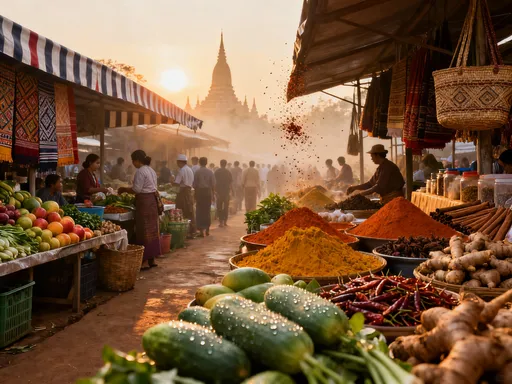
Siem Reap’s Phsar Leu, commonly known as the Morning Market, pulses with the rhythm of everyday Cambodian life. Open before dawn and most vibrant by mid-morning, this sprawling marketplace is where locals come to buy fresh ingredients, household goods, and clothing. Unlike tourist-centric bazaars, Phsar Leu offers an unfiltered look at Khmer culture in motion. The air hums with chatter, the clatter of woks, and the occasional call of a vendor hawking ripe mangoes or bundles of fragrant basil. Bright pyramids of dragon fruit, rambutan, and green papaya rise beside baskets of dried fish and pungent prahok, a fermented fish paste central to Cambodian cuisine. The market is organized into zones—produce, meat, textiles, and prepared foods—each section offering its own sensory narrative.
One of the most captivating areas is the spice aisle, where mounds of turmeric, galangal, lemongrass, and kaffir lime leaves spill from woven trays. These are not packaged for export but sold in loose handfuls, measured by hand. Vendors patiently explain uses for lesser-known herbs like srao (a bitter leaf used in soups) or chi krasang (a wild pepper). Nearby, women in traditional kramas—checkered cotton scarves—sit cross-legged, weaving reed mats or folding banana leaves into containers for steamed snacks. The clothing stalls offer everything from school uniforms to hand-embroidered blouses, many stitched by local seamstresses working from home.
Shopping at Phsar Leu is more than a transaction; it’s an act of participation. Every purchase supports a family, a small business, or a home-based artisan. A $2 bundle of fresh herbs might feed a grandmother’s kitchen for two days, while a $10 cotton dress could cover a child’s school supplies for a week. Travelers who visit are encouraged to arrive early, ideally between 6:00 and 9:00 a.m., when the market is at its liveliest and temperatures are mild. It’s also the best time to witness how locals shop—touching produce gently, haggling with a smile, and exchanging news with neighbors.
For visitors, a few respectful practices go a long way. Bargaining is acceptable but should be done gently, especially with elderly or low-income vendors. A polite smile and modest offer are more effective than aggressive negotiation. It’s also wise to carry small bills and avoid flashing large amounts of cash. Photography should be approached with care—always ask permission before taking photos of people or their stalls. A simple nod or hand gesture can open a friendly exchange. Above all, come with curiosity and humility. The Morning Market isn’t a performance for tourists; it’s a working marketplace where dignity and daily survival intersect.
Art That Tells a Story: Craft Villages Beyond the Temples
Beyond the shadow of Angkor Wat, Cambodia’s artistic soul thrives in quiet villages where tradition is passed from hand to hand. Places like Artisans Angkor and the silk-weaving hamlets of Tani and Puok are not just workshops—they are guardians of heritage. Here, skills that nearly vanished during decades of conflict are being revived with quiet determination. Silk farming, once a royal craft, is now a source of pride and livelihood for rural families. Women tend to silkworms, harvest cocoons, and hand-dye threads using natural pigments from jackfruit, indigo, and ebony bark. The resulting fabrics shimmer with earthy hues—ochre, deep green, and soft maroon—each pattern carrying symbolic meaning.
Traditional motifs are more than decoration; they are visual language. The naga, or serpent, represents protection and water, a nod to Cambodia’s agrarian roots. The hol pattern, resembling a twisted rope, symbolizes continuity and resilience. These designs are woven into scarves, shawls, and wall hangings, each piece taking days or even weeks to complete. In silver workshops, artisans hammer intricate temple scenes into bracelets and boxes, their tools little changed from centuries past. Stone carvers, often working in open-air sheds, chisel replicas of ancient deities with a reverence that borders on devotion.
What makes these craft villages remarkable is their commitment to authenticity and sustainability. Unlike mass-produced souvenirs sold in airport shops, these items are made in limited quantities, using time-honored methods. Artisans Angkor, for example, operates as a social enterprise, training young people in traditional arts and ensuring fair wages. Visitors can tour the workshops, watch demonstrations, and even try their hand at weaving or carving. The experience transforms a simple purchase into a meaningful exchange—one that honors the maker and preserves a legacy.
Buying directly from these communities ensures that more of the value goes to the artisan. A $25 silk scarf supports a weaver’s family, while a $50 carved wooden box funds a child’s education. These purchases do more than decorate a home; they sustain a culture. For the traveler, they become touchstones of memory—a tangible link to the hands that shaped them. In a world of fast fashion and disposable goods, these crafts remind us of the beauty of slowness, intention, and skill.
From Temple to Table: Food Markets as Cultural Gateways
In Siem Reap, food is not just sustenance—it is memory, identity, and hospitality. The Angkor Night Market and countless roadside stalls offer a culinary journey as rich as any temple tour. Here, the Khmer palate comes alive in dishes like amok, a creamy fish curry steamed in banana leaves, and nom banh chok, a breakfast favorite of rice noodles topped with a fragrant green fish sauce. Spring rolls, filled with shrimp and herbs, are rolled to order, their translucent wrappers glistening under string lights. Each bite tells a story of land, labor, and lineage.
The ingredients themselves are cultural artifacts. Kroeung, a paste made from lemongrass, turmeric, and garlic, forms the base of many Khmer dishes. It’s pounded fresh daily, releasing a citrusy aroma that lingers in the air. Prahok, though strong-smelling, is a staple, used to deepen the flavor of soups and dips. Even the rice—often jasmine or sticky—is more than a side dish; it’s a symbol of life and abundance. Vendors proudly display heirloom varieties, some grown in family plots for generations.
For travelers, eating at local markets is an act of cultural respect. It shows willingness to step beyond comfort zones and embrace another way of life. To do so wisely, a few practical tips help. Look for stalls with high turnover—freshness is key. Observe hygiene: are utensils clean? Is food kept hot or properly chilled? Many locals rely on these stalls daily, so a busy queue is often a good sign. Bottled water and cooked-to-order dishes minimize risk, while raw salads or unpeeled fruit should be approached with caution.
But beyond safety, there’s a deeper etiquette. A smile, a thank you in Khmer (“awkun”), and a willingness to eat as locals do—perched on a low plastic stool—can open doors to connection. Some vendors, touched by genuine interest, might share a recipe or explain how their grandmother taught them to roll spring rolls. These moments, fleeting but profound, turn a meal into a memory. In a world where food is increasingly globalized, Siem Reap’s markets remind us that flavor is rooted in place, and every dish carries a history worth savoring.
Beyond Souvenirs: Finding Meaning in Handmade Goods
It’s easy to leave Siem Reap with a bag full of trinkets—keychains, fridge magnets, mass-produced carvings stamped “Made in China.” But for those who look deeper, the market offers something more valuable: handmade objects born of skill, patience, and tradition. A batik scarf, dyed with natural wax and plant pigments, carries the rhythm of the artisan’s hand. A wooden mask, carved from sustainably sourced wood, echoes the spiritual art of ancient Khmer theater. These items are not just decorative; they are heirlooms in the making.
I remember watching an elderly craftsman in a shaded stall near Pub Street, his hands gnarled but steady as he chiseled the face of a guardian lion. When I asked about his work, he smiled and said, “My father taught me this. Now I teach my grandson.” That moment shifted my perspective. My purchase was no longer just a transaction—it was a thread in a larger story. Unlike factory-made souvenirs, handmade goods have a soul. They bear the marks of their making: a slight asymmetry, a variation in color, a brushstroke that only the artist could have made.
Choosing handmade is also an ethical decision. It supports individuals, not corporations. It values time over speed, quality over quantity. For many artisans, especially women in rural areas, this income is essential. It pays for school fees, medical care, and home repairs. When travelers prioritize these goods, they help preserve skills that might otherwise fade. Moreover, they foster a sense of dignity. An artisan is not a vendor to be bargained down to pennies; they are a keeper of knowledge worthy of respect.
For the buyer, these items become more than decorations. They are conversation starters, memory anchors, and cultural bridges. A hand-painted temple scene on silk might hang in a living room, sparking stories of Cambodia’s golden age. A hand-carved spoon could be used daily, a quiet reminder of craftsmanship. In this way, mindful shopping transforms travel from consumption to connection. It invites us to see the person behind the product and to honor the legacy they carry forward.
Design Meets Tradition: Modern Boutiques with a Khmer Soul
While Siem Reap honors its past, it is also embracing the future through a new generation of designers who blend tradition with innovation. Boutiques like Sister Srey, Ploy Handicrafts, and Java Coffee Shop’s gift section offer products that feel both contemporary and deeply Cambodian. These spaces are not just stores—they are platforms for social change. Many operate as social enterprises, employing women from vulnerable backgrounds and training them in sustainable crafts.
Sister Srey, for instance, works with single mothers and survivors of trafficking, teaching them to sew, embroider, and design. Their products—tote bags, clutches, and aprons—feature modern silhouettes with traditional motifs. A simple cotton bag might be embroidered with a naga pattern in silk thread, merging ancient symbolism with everyday utility. Ploy Handicrafts specializes in upcycled materials, turning discarded saris and fabric scraps into vibrant patchwork purses and cushions. Each piece is one-of-a-kind, reflecting both creativity and environmental responsibility.
These boutiques also reimagine Khmer aesthetics for global tastes. Minimalist silver jewelry, inspired by Angkor’s intricate carvings, appeals to modern sensibilities while honoring heritage. Hand-thrown ceramics, glazed in earthy tones, echo the shapes of ancient pottery. Even home goods—candles, notebooks, tea sets—carry subtle nods to Cambodian artistry. The result is a new kind of souvenir: beautiful, functional, and meaningful.
Shopping at these boutiques does more than support artisans—it empowers communities. Profits often fund education, healthcare, or housing initiatives. Some stores partner with local NGOs to expand their impact. For the traveler, these purchases feel aligned with values: sustainability, equity, and cultural respect. They reflect a desire not just to take, but to give back. In a world where tourism can sometimes feel extractive, these spaces offer a model of reciprocity. They prove that tradition and modernity can coexist, and that beauty can be both timeless and timely.
The Ethics of Exchange: How to Shop Respectfully in Siem Reap
Tourism brings opportunity, but it also carries responsibility. In a city where many families depend on visitor spending, the way we shop matters. Respectful shopping means more than polite behavior—it means understanding the power dynamics at play. A $5 purchase might seem small to a traveler, but to a vendor, it could be a day’s wages. Bargaining is common, but it should never come at the cost of dignity. A fair price is one that acknowledges the value of the craft and the livelihood it supports.
One of the most important guidelines is to avoid exploitative markets—those that sell counterfeit goods, exploit child labor, or appropriate sacred symbols. Genuine handicrafts take time and skill; if a price seems too good to be true, it likely is. Be cautious of items that mimic religious icons or traditional attire sold as costumes. These can cross the line from appreciation to appropriation. Instead, seek out vendors who can explain the story behind their products—where the materials come from, who made them, and what the designs mean.
Photography is another area that requires sensitivity. While it’s natural to want to capture the vibrant scenes, always ask before photographing people. A simple gesture or smile can make the difference between intrusion and connection. Some vendors may welcome photos; others may prefer privacy. Respecting that choice builds trust and honors their agency.
Supporting community-based initiatives is one of the most impactful choices a traveler can make. Whether it’s a cooperative, a training center, or a women’s collective, these organizations ensure that benefits are shared widely. They also provide stability in an economy often shaped by seasonal tourism. By choosing to shop with intention, travelers become allies in cultural preservation. Shopping, then, is not just about what we take home—it’s about the relationships we build and the values we uphold.
Bringing Culture Home: Making Your Purchases Last
The true value of a travel memento lies not in its price or rarity, but in the story it carries. A handwoven scarf, a jar of kroeung paste, a small wooden statue—these are not just objects. They are vessels of memory, culture, and human connection. When we bring them home, we have a choice: to let them gather dust, or to honor their origins.
One way to do this is through storytelling. Share the name of the artisan, the village where an item was made, or the meaning behind a design. Display pieces with context—a note card, a photo, or a simple plaque. This transforms decoration into education. It invites others to appreciate not just the object, but the culture it represents.
Another way is through use. Cook a dish using ingredients bought in the market. Wear a scarf to a gathering and explain its significance. Let these items live in your daily life, not just on a shelf. Some travelers even learn to make the crafts they admire—taking a weaving class or trying a recipe from memory. These acts deepen the connection and keep traditions alive in new places.
In the end, shopping in Siem Reap is not about accumulation. It’s about participation. It’s about recognizing that every purchase is a thread in a larger tapestry—one woven with skill, history, and hope. When we shop with awareness, we don’t just take something home. We carry a piece of Cambodia’s spirit with us, and in return, we help ensure that its artisans, its flavors, and its stories continue for generations to come.