Uncovering Delphi’s Hidden Architectural Wonders – A Traveler’s Real Talk
Nestled on the slopes of Mount Parnassus, Delphi isn’t just a stop on a history tour—it’s a journey through time. I never expected ancient stones to feel so alive. From the majestic Theater to the sacred Temple of Apollo, every structure tells a story. This is more than sightseeing; it’s about feeling the pulse of a place where architecture meets myth. The way the ruins rise from the cliffs, framed by sky and olive groves, creates a sense of awe that lingers long after you leave. You don’t just walk through Delphi—you absorb it. And while many come for the oracle, the true marvel lies in how thoughtfully every stone was placed, how precisely the buildings align with the sun and terrain, and how deeply the architecture reflects a civilization that valued balance, beauty, and divine connection. You gotta see it to believe it.
Arriving in Delphi: First Impressions That Stick
Reaching Delphi is an experience in itself, one that begins long before you step onto the archaeological site. The journey winds up the slopes of Mount Parnassus, where narrow roads carve through dense pine forests and terraced hillsides. As the elevation climbs, so does the sense of anticipation. The air grows cooler, the light softer, and then, suddenly, the valley opens up. There it is—Delphi, perched like a crown above the Gulf of Corinth, its ruins scattered across the mountainside with quiet dignity. Visitors often describe their first glimpse as humbling, not just because of the panoramic views, but because of how seamlessly the ancient structures blend into the natural landscape. Unlike many archaeological sites that feel isolated or artificially preserved, Delphi appears as though it has always belonged to this place, as if the mountain itself gave birth to these stones.
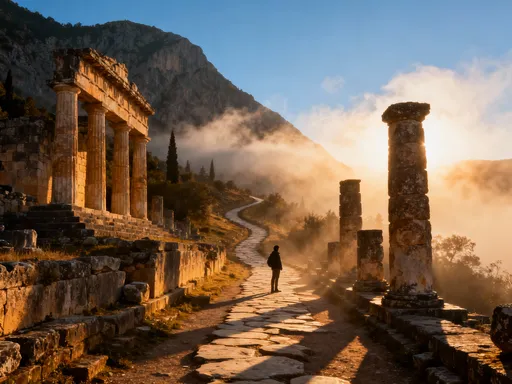
This harmony between architecture and environment is no accident. The ancient Greeks were master planners who believed that sacred spaces should reflect cosmic order. Delphi, considered the center of the world in antiquity—the famed “navel of the Earth”—was deliberately sited to inspire reverence. The sanctuary was built on a steep incline, forcing visitors to ascend gradually, both physically and spiritually. Each turn in the path reveals a new perspective: a crumbling column bathed in golden light, a terrace offering a sweeping view of the valley below, or a weathered inscription half-buried in the earth. These moments are not incidental; they are part of a carefully orchestrated experience designed to elevate the soul. Modern travelers, accustomed to flat museums and fenced-off ruins, are often unprepared for how immersive Delphi feels. You don’t observe it from a distance—you become part of its rhythm.
What sets Delphi apart from other ancient sites is this emotional resonance. While places like the Acropolis or Ephesus impress with scale and preservation, Delphi moves you. It’s the silence between the stones, the whisper of wind through the columns, the way sunlight shifts across the marble as the day progresses. The architecture doesn’t shout; it murmurs. And in that quiet, there’s a powerful invitation—to slow down, to look closely, to listen. For families, couples, and solo travelers alike, this first impression often becomes the foundation of a deeper connection to history. It’s not just about understanding what happened here; it’s about feeling what it meant to be here. That emotional depth, rooted in the site’s thoughtful design and breathtaking setting, is what makes Delphi unforgettable.
The Sacred Way: Walking the Ancient Path
The heart of Delphi’s sanctuary is the Sacred Way, a cobbled path that winds uphill through the ruins like a spine connecting the body of the site. This was no ordinary road—it was a pilgrimage route, walked for centuries by Greeks from every city-state who came to consult the oracle or dedicate offerings to Apollo. Today, walking the Sacred Way is one of the most evocative experiences a visitor can have. Each step takes you deeper into the past, past the remains of treasuries, altars, and victory monuments that once shimmered with bronze and paint. Though time has stripped away much of their color and grandeur, the architectural details still speak volumes. Doric columns stand in silent rows, their fluted shafts catching the light. Inscriptions, carved in elegant Greek script, hint at the names of cities and individuals who once sought favor from the gods. Even the alignment of the buildings—angled just so to catch the morning sun—reveals a civilization obsessed with precision and symbolism.
What’s remarkable about the Sacred Way is how it combines function with meaning. It wasn’t merely a path from point A to point B; it was a ritual journey, designed to prepare the visitor for divine encounter. The gradual ascent mirrored a spiritual climb, with each monument serving as a waypoint in a larger narrative of devotion and gratitude. The treasuries—small temple-like structures built by different city-states—were more than storage houses for gifts; they were statements of pride and piety. The Athenian Treasury, one of the best-preserved, showcases classic Doric architecture with its sturdy columns and intricate metopes depicting the labors of Hercules. Standing before it, you can almost imagine the Athenian envoys placing their offerings inside, hoping to secure Apollo’s favor in war or politics.
But beyond the individual structures, the Sacred Way teaches us about ancient Greek urban planning. The path curves naturally with the terrain, avoiding steep grades and maximizing views. Buildings are positioned not only for visibility but also for symbolic importance—closer to the Temple of Apollo, the structures grow more sacred, more central to the religious experience. This intentional layout reflects a society that valued order, proportion, and hierarchy. Modern visitors, used to grid-like city streets and utilitarian sidewalks, may not immediately notice these subtleties. But with a little attention, the genius of the design becomes clear. The Sacred Way isn’t just a road through ruins—it’s a lesson in how architecture can shape behavior, guide emotion, and elevate the human spirit.
Temple of Apollo: Heart of the Oracle
At the center of Delphi’s spiritual and architectural universe stands the Temple of Apollo, the sacred chamber where the Pythia, the oracle’s priestess, delivered her cryptic prophecies. Though only the foundation and a few column drums remain today, the site’s power is undiminished. Standing on the temple platform, you can feel the weight of history—the countless rulers, generals, and ordinary citizens who once waited here for divine guidance. The temple’s location was no accident; it sat directly above a geological fault line, where ancient sources describe vapors rising from the earth, believed to inspire the oracle’s visions. Whether these fumes were real or symbolic, the temple’s design reinforced the belief in its supernatural significance. Its east-west orientation ensured that the first rays of the morning sun would illuminate the inner sanctum, a daily reminder of Apollo’s connection to light and truth.
Architecturally, the Temple of Apollo followed the classic Doric order, with sturdy columns, a pedimented roof, and a layout that emphasized symmetry and balance. It measured approximately 21 by 58 meters, with six columns across the front and fifteen along each side—a standard yet majestic proportion for a major sanctuary. The columns, made of local limestone and capped with marble, were designed to support a wooden roof covered in terracotta tiles. While no complete structure survives, archaeological evidence and ancient descriptions allow us to reconstruct its former grandeur. The temple was not just a place of worship; it was a statement of civic and religious authority. Its elevated position, visible from much of the sanctuary, reminded all who approached that Apollo’s word was supreme.
The influence of the Temple of Apollo extended far beyond Delphi. Its architectural principles—harmony, proportion, and alignment with natural and celestial forces—became models for other Greek temples, from Sicily to Asia Minor. The idea that a building could mediate between humans and gods, that its form could reflect cosmic order, was central to Greek religious thought. Even today, echoes of this design philosophy can be seen in neoclassical buildings around the world, from courthouses to museums. For the modern traveler, the temple’s ruins are more than a photo opportunity; they are an invitation to reflect on how ancient people understood their place in the universe. To stand where the Pythia once sat is to touch a legacy of belief, wisdom, and architectural brilliance that still resonates across millennia.
Delphi’s Theater: Where Drama Met the Divine
Carved directly into the mountainside, Delphi’s ancient theater is one of the best-preserved in Greece and a masterpiece of Hellenic engineering. Perched above the Temple of Apollo, it offered spectators not only a stage but a panorama—rolling hills, distant peaks, and the sky itself formed a natural backdrop to the performances. Built in the 4th century BCE and later renovated during Roman times, the theater could seat around 5,000 people on its 35 marble tiers. The acoustics remain astonishing; even today, a whisper from the stage can be heard clearly in the top rows. This was no accident. Greek architects understood sound propagation and designed the semicircular seating to amplify voices, ensuring that every citizen, rich or poor, could hear the dramas, hymns, and announcements performed here.
But the theater was not merely a venue for entertainment. It played a vital role in the religious and cultural life of Delphi. During the Pythian Games—a festival held in honor of Apollo—musical and theatrical competitions were central events. Poets, actors, and musicians from across Greece came to perform, hoping to win laurel wreaths and eternal fame. The plays themselves often drew from myth, exploring themes of fate, justice, and the will of the gods—subjects deeply connected to the oracle’s messages. In this way, the theater extended the sanctuary’s spiritual mission, using art to interpret and reflect divine truths. The architecture supported this dual purpose: the stage building (skene) was modest compared to later Roman theaters, keeping the focus on the performers and the natural setting, reinforcing the idea that art and nature were both expressions of the divine.
For modern visitors, sitting in the theater offers a rare moment of connection. Close your eyes, and you can almost hear the chorus chanting, the flute playing, the crowd reacting to a tragic revelation. Open them, and you’re reminded of the Greeks’ profound respect for both human expression and the natural world. The theater’s integration with the landscape—its curves following the hillside, its materials drawn from local stone—exemplifies the Greek ideal of harmony. It wasn’t built *on* the mountain; it was built *with* the mountain. This sensitivity to environment is something contemporary architects still study and admire. For families visiting Delphi, the theater is often a highlight—not just for its history, but because it’s a place where imagination can run free. Children can picture ancient actors in masks, adults can reflect on the timeless power of storytelling, and all can appreciate how a 2,400-year-old structure still speaks so clearly.
The Stadium: Athletic Legacy in Stone
Perched even higher than the theater, Delphi’s stadium is one of the highest in ancient Greece, sitting at over 570 meters above sea level. Built in the 5th century BCE and expanded during the Roman period, it hosted the athletic events of the Pythian Games, a festival second only to the Olympics in prestige. The stadium could accommodate about 7,000 spectators, who gathered on stone benches cut directly into the hillside. The track, measuring approximately 177 meters in length, was made of packed earth, and the starting blocks—low walls with cutouts for runners’ toes—still survive at one end. Walking the length of the track today, you can almost feel the energy of ancient sprinters, wrestlers, and charioteers who competed here in honor of Apollo, god of light, music, and physical perfection.
The design of the stadium reflects both practicality and symbolism. Its elongated U-shape maximized visibility, while the natural slope of the mountain eliminated the need for complex support structures. The lack of a roof allowed sunlight to flood the arena, reinforcing the connection between athletic excellence and divine favor. Unlike modern sports venues with artificial lighting and synthetic surfaces, Delphi’s stadium relied entirely on natural elements—sun, wind, earth—reminding athletes and spectators alike that human achievement was part of a larger cosmic order. The games themselves were more than competitions; they were religious rituals, believed to please the gods and ensure prosperity for the community.
What’s particularly striking is how architecture and ideology worked together. The stadium wasn’t hidden away or treated as secondary to the temples—it was integrated into the sacred landscape, just a short climb from the Temple of Apollo. This placement sent a clear message: physical strength and discipline were as important as spiritual devotion. The victors received not just fame, but eternal honor, with their names inscribed on stone and their statues displayed in the sanctuary. For today’s visitors, walking through the stadium is a powerful reminder of how the Greeks balanced mind, body, and spirit. Parents often point out the starting blocks to their children, explaining how young athletes trained for years to compete here. It’s a moment of education and inspiration, showing how ancient values—excellence, perseverance, respect—were built into the very stones of Delphi.
Beyond the Ruins: Modern Access and Visitor Experience
While Delphi’s ancient architecture speaks across time, the modern visitor experience is shaped by thoughtful planning and preservation efforts. The archaeological site is managed by the Greek Ministry of Culture, with clear signage, well-maintained paths, and a small on-site museum that houses artifacts like the famous Charioteer statue and inscribed tablets from the sanctuary. Tickets can be purchased at the entrance, and combo passes are available for those also visiting the museum or nearby attractions. For the best experience, it’s recommended to arrive early in the morning or later in the afternoon, when the light is soft and the crowds are thinner. Summer months can be busy, especially during weekends and holidays, so booking a guided tour in advance is a smart move for families or first-time visitors.
Accessibility is a consideration at Delphi, given its mountainous terrain. While the main paths are paved and generally well-graded, there are steep sections and uneven surfaces, particularly around the stadium and theater. Sturdy walking shoes are essential, and visitors with mobility challenges may find some areas difficult to navigate. Rest areas with benches are available, and there’s a small café near the entrance offering refreshments and light snacks. Restrooms are clean and well-maintained, though they can get crowded during peak hours. Families will appreciate the open spaces, where children can walk safely under supervision, and the sense of discovery that comes with exploring each new ruin.
Guided tours, led by licensed archaeologists or historians, greatly enhance understanding of the site. These professionals can point out subtle architectural details—like the precision of column alignments or the symbolism of inscriptions—that casual visitors might miss. Audio guides are also available in multiple languages and offer a flexible alternative. For those interested in deeper exploration, combining a visit to the archaeological site with the Delphi Archaeological Museum provides a fuller picture of the sanctuary’s significance. And for the truly curious, nearby hiking trails lead to the Castalian Spring and the ruins of the ancient gymnasium, offering quieter, less-visited corners of the Delphic world. With a little preparation, the modern journey to Delphi can be as enriching as the ancient one.
Why Delphi’s Architecture Still Matters Today
The ruins of Delphi are not relics of a forgotten past; they are living lessons in design, philosophy, and human aspiration. What makes Delphi’s architecture timeless is not just its beauty, but its principles—harmony with nature, balance in proportion, and intentionality in placement. These are not ancient quirks; they are insights that continue to inform modern architecture and urban planning. Today’s sustainable design movements, which emphasize energy efficiency, natural materials, and integration with the environment, echo the very choices the Greeks made over two millennia ago. They built with the sun, not against it. They followed the contours of the land, rather than flattening it. They created spaces that elevated the human spirit, not just sheltered the body.
Delphi also reminds us that great architecture serves a purpose beyond utility. It shapes how we think, feel, and connect—with each other and with something greater. The Sacred Way guided pilgrims toward revelation. The Temple of Apollo stood as a symbol of divine order. The theater and stadium celebrated the unity of art, sport, and spirituality. In an age of glass towers and cookie-cutter developments, Delphi challenges us to ask: what should our buildings say about us? Are they merely functional, or do they inspire? Do they belong to their environment, or dominate it?
For travelers, especially those in their 30s to 50s who may be seeking meaning as much as sightseeing, Delphi offers a rare opportunity—to slow down, to observe, to reflect. It invites you to look beyond the myths and truly see the genius in the stones. You don’t need to believe in oracles to feel the weight of history here. You only need to walk the path, sit in the theater, stand on the temple platform, and let the architecture speak. Because in the end, Delphi is not just a destination. It’s a conversation across time—one that continues, one stone at a time.