How I Regained My Balance and Rebuilt Strength After Injury – A Real Journey
Losing balance isn’t just about falling—it’s the fear, the frustration, the slow loss of independence. After my injury, simple walks became daunting. But over time, with patience and the right moves, I rebuilt my stability from the ground up. This isn’t a quick fix—it’s a real, long-term recovery. If you’re struggling with balance or post-injury recovery, this journey might just mirror your own path forward. Recovery isn’t measured in days but in small victories: standing without support, walking without hesitation, trusting your body again. This is a story of resilience, science, and everyday strength.
The Hidden Impact of Poor Balance
Beyond the physical risk of falls, poor balance quietly erodes quality of life. It affects how confidently a person moves through their home, how safely they navigate stairs, and how independently they perform daily tasks like cooking or dressing. For many, especially those recovering from injury or managing the natural changes of aging, imbalance becomes a hidden barrier to freedom. The fear of falling can be more limiting than the injury itself, leading to reduced activity, social withdrawal, and a cycle of weakening muscles and declining coordination.
Balance is not just a physical skill—it’s a complex integration of sensory input, muscular response, and brain processing. The body relies on signals from the eyes, inner ear (vestibular system), and sensory nerves in the feet and joints (proprioception) to maintain stability. When one of these systems is disrupted—whether by injury, illness, or disuse—the entire network is affected. This interconnectedness means that even a minor ankle sprain can have long-term consequences on overall stability if not properly addressed through targeted recovery.
What makes balance so often overlooked is its invisibility until it’s gone. People rarely think about their ability to stand on one foot or turn quickly without stumbling—until they can’t. Yet, strong balance is foundational to mobility, independence, and long-term health. Research shows that individuals with better balance are less likely to experience falls, hospitalizations, and loss of autonomy as they age. Rebuilding it isn’t just about safety; it’s about reclaiming confidence and the ability to live fully.
Why Balance Deteriorates: Understanding the Root Causes
Balancing ability doesn’t disappear overnight. It typically declines due to a combination of factors, many of which are preventable or reversible. Injury—particularly to the lower limbs, spine, or nervous system—can disrupt the body’s ability to process movement signals. A broken ankle, for example, may heal structurally, but the surrounding muscles weaken and the brain’s connection to that foot can become less responsive. Without proper rehabilitation, the body compensates in ways that further destabilize movement patterns.
Aging plays a role, but it’s not the sole culprit. As people grow older, natural changes occur: muscle mass decreases, reaction times slow, and the vestibular system in the inner ear may lose sensitivity. However, these changes are often accelerated by inactivity. A sedentary lifestyle leads to muscle atrophy, reduced joint mobility, and diminished neural signaling—all critical components of balance. The body adapts to the demands placed on it; if those demands are minimal, the systems responsible for stability begin to degrade.
Neurological conditions such as peripheral neuropathy, Parkinson’s disease, or stroke can also impair balance, but even in these cases, improvement is possible through consistent training. The nervous system has a remarkable capacity for adaptation, known as neuroplasticity. This means that with the right stimuli, the brain can rewire its connections and improve coordination over time. The key is understanding that imbalance is not an inevitable consequence of age or injury—it is often a symptom of underuse, not incapacity.
Recognizing these root causes is the first step toward recovery. It shifts the mindset from resignation to empowerment. Instead of accepting instability as a permanent condition, individuals can begin to see it as a signal—a call to rebuild strength, retrain coordination, and restore confidence. The body is designed to move, and when movement is reintroduced safely and systematically, balance can return.
My Turning Point: When I Knew I Had to Change
The moment everything changed wasn’t dramatic—it was quiet, humbling, and deeply personal. I reached for a mug on a high shelf, shifted my weight, and suddenly my leg gave way. I didn’t fall hard, but the shock was worse than the stumble. I sat on the kitchen floor, embarrassed and shaken, realizing I couldn’t stand without bracing myself against the counter. That small incident stripped away the illusion that I was healing on my own. The truth was, I had been avoiding the work, hoping my body would just ‘figure it out.’ But it wouldn’t.
The emotional toll of that fall lingered longer than the physical discomfort. I began to notice how much I relied on walls, furniture, or a loved one’s arm to move through my day. Simple tasks like stepping into the shower or getting out of the car required planning and effort. The independence I once took for granted was slipping away, and with it, a sense of self-reliance. I felt frustrated, not just with my body, but with my own avoidance. I had been waiting for recovery to happen, instead of actively participating in it.
That realization became my turning point. I decided to stop treating balance as a side effect of healing and start treating it as a central goal. I consulted a physical therapist who helped me understand that recovery wasn’t about pushing harder, but about moving smarter. We focused on re-educating my nervous system, reactivating dormant muscles, and rebuilding trust in my body’s ability to support me. It wasn’t about speed—it was about consistency, precision, and patience.
This shift in mindset was transformative. Instead of viewing exercises as chores, I began to see them as acts of self-care, small promises to myself that I would not accept limitation. I learned to celebrate progress that wasn’t visible—like standing on one foot for five seconds longer, or walking across the room without looking down. Recovery became less about fixing a problem and more about reconnecting with my body, one mindful movement at a time.
The Foundation: Rebuilding from the Ground Up
Balance begins where the body meets the ground—the feet. Strong, responsive feet provide a stable base for all movement. Yet, after an injury, foot strength is often neglected. Shoes, orthotics, and reduced activity can lead to weakened arches, stiff ankles, and diminished sensory feedback from the soles. Rebuilding balance starts with reawakening this foundation. Simple exercises like towel scrunches—using the toes to pull a towel across the floor—help restore intrinsic foot muscle strength. Heel and toe raises improve calf and shin activation, enhancing stability during walking.
Posture is equally critical. Slouching or leaning shifts the center of gravity, making balance more difficult. A neutral spine—ears aligned over shoulders, shoulders over hips, hips over ankles—creates optimal alignment for weight distribution. Practicing this posture while standing in front of a mirror or against a wall helps train body awareness. Over time, correct alignment becomes habitual, reducing strain on joints and improving overall control.
Core stability is the bridge between lower and upper body coordination. The deep abdominal and back muscles act like a natural corset, supporting the spine and enabling smooth, controlled movement. Exercises such as pelvic tilts, gentle bridges, and seated marches engage these muscles without strain. These movements may seem minor, but they lay the groundwork for more complex balance challenges. The principle is clear: stability begins in the core, transfers through the hips, and is expressed in the feet.
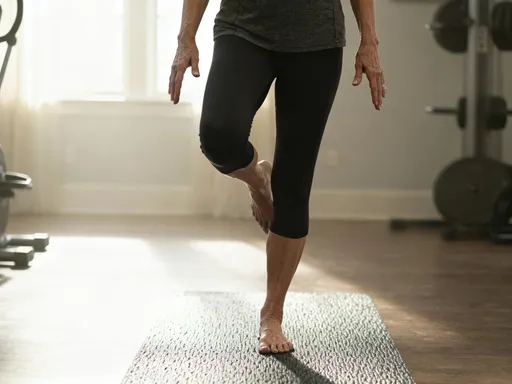
One of the most effective foundational exercises is weight shifting. Standing with feet hip-width apart, slowly shifting weight from side to side, then forward and backward, trains the body to adjust to movement without losing balance. This simple practice enhances ankle mobility and strengthens the muscles responsible for micro-corrections during daily activities. Another key exercise is the heel-to-toe walk—placing one foot directly in front of the other, as if walking on a tightrope. This challenges balance in a functional way, mimicking real-world navigation through narrow spaces.
The most important factor in this phase is consistency. These exercises don’t require intensity or long durations—just daily repetition. Five minutes in the morning and five at night can produce measurable improvements over weeks. The body responds to frequency, not force. By focusing on small, sustainable efforts, the foundation for lasting balance is securely laid.
Movement as Medicine: Integrating Functional Training
Recovery doesn’t have to happen only during formal exercise sessions. Functional training—using everyday movements to build strength and coordination—turns daily life into a practice ground for balance. Standing on one leg while brushing teeth, waiting for the kettle to boil, or holding onto the counter while drying off after a shower are all opportunities to train stability. These micro-practices integrate balance work seamlessly into routine, making it accessible and sustainable.
Tai chi, a low-impact mind-body practice, has been widely studied for its benefits in improving balance and reducing fall risk, especially in older adults. Its slow, controlled movements enhance coordination, focus, and joint mobility. Even practicing just ten minutes a day can lead to noticeable improvements in steadiness. Similarly, resistance training with elastic bands builds strength in the legs and hips without putting stress on joints. Exercises like seated leg extensions, standing hip abductions, and gentle squats against a wall activate key stabilizing muscles.
Progressive overload—the gradual increase of challenge—is essential for long-term gains. Just as muscles adapt to heavier weights, the balance system adapts to greater instability. This means slowly introducing more difficult variations: closing the eyes during a stand, standing on a cushioned surface, or increasing the duration of single-leg holds. These adaptations should be introduced carefully, ensuring safety and control. The goal is not to rush progress but to allow the body to adjust over weeks and months.
Walking itself becomes a therapeutic tool. Starting with short, supported walks and gradually increasing distance and terrain complexity—such as walking on grass or slight inclines—builds endurance and confidence. Using a walking aid, if needed, is not a setback but a support that enables safer progression. Over time, reliance on assistive devices often decreases as strength and coordination improve. The key is to view every movement as a step toward greater independence.
Mind-Body Connection: The Role of Focus and Proprioception
Balancing is not just a physical act—it requires mental engagement. The brain must process sensory input, make split-second adjustments, and coordinate muscle responses. This is where focus becomes a powerful tool. Simply paying attention to how the body feels during a stand or step enhances neural communication. Closing the eyes during a two-footed stand, for example, removes visual input and forces the body to rely more on inner ear and joint feedback. This strengthens proprioception—the body’s internal sense of position and movement.
Proprioception training is especially important after injury, when the brain’s connection to the affected limb may be weakened. Simple exercises like standing on a foam pad or textured mat increase sensory stimulation through the feet, helping the nervous system recalibrate. Another effective practice is the tandem stand—placing one foot directly in front of the other, heel to toe—and holding the position for 20 to 30 seconds. This narrow base of support challenges balance and sharpens neuromuscular control.
Mindfulness amplifies these benefits. By bringing awareness to breath, posture, and muscle engagement, individuals create a deeper connection between thought and movement. This doesn’t require meditation in the traditional sense—just a few moments of intentional focus during daily activities. For example, while standing in line, one might notice foot pressure, alignment, and breathing. These small acts of awareness train the brain to stay present in the body, reducing the risk of distraction-related stumbles.
Over time, this mind-body integration transforms balance from a conscious effort into an automatic skill. The body learns to correct itself before a misstep occurs. This anticipatory control is what separates functional stability from mere static balance. It’s the difference between reacting to instability and preventing it altogether.
Long-Term Maintenance: Making Balance a Lifestyle
Improved balance is not a destination—it’s an ongoing practice. Just as physical fitness requires regular activity, stability must be maintained through consistent effort. The gains made during recovery can be preserved by incorporating balance exercises into a daily routine. Habit stacking—linking a new behavior to an existing one—makes this easier. For example, doing heel raises while waiting for the coffee to brew or practicing a single-leg stand during a TV commercial turn maintenance into a seamless part of life.
Environmental adjustments also play a crucial role in long-term safety. Removing loose rugs, improving lighting, installing grab bars in bathrooms, and wearing supportive footwear reduce fall risks at home. These changes create a safer space, allowing for more confident movement. Additionally, choosing shoes with low heels, firm soles, and good arch support enhances stability during daily activities.
Staying socially active and physically engaged supports overall mobility. Group classes such as tai chi, water aerobics, or gentle yoga provide both physical benefits and emotional support. These settings encourage accountability and make exercise more enjoyable. The combination of physical challenge and social connection fosters motivation and long-term adherence.
The ultimate goal is not perfection but resilience—the ability to recover quickly from a stumble and continue moving forward. Balance is not about never wobbling; it’s about trusting that the body can correct itself. This confidence transforms the experience of aging and recovery from one of fear to one of empowerment.
Recovery is not linear. There will be days of progress and days of setback. What matters is the commitment to showing up, even when progress feels slow. Every small effort contributes to a stronger, more stable body. The journey from instability to regained control is not defined by dramatic breakthroughs, but by quiet persistence. With the right approach—grounded in science, supported by consistency, and sustained by mindset—improved balance is not only possible, it is life-changing. Always consult with a healthcare professional before beginning any new exercise program, especially after injury. And remember: every step, no matter how small, is a step toward greater freedom.